Distributed AI Chat (Multi-Agent Swarm Architecture)
FeaturedA transparent, real-time multi-agent AI system where specialized agents collaborate to produce higher-quality answers.
Overview
This project is a distributed, multi-agent AI chat system where multiple specialized agents collaborate in real time to answer complex questions. Instead of relying on a single LLM response, the system orchestrates a swarm of agents, each with a distinct role, and synthesizes their outputs into a final, coherent answer.
Domain: Agentic AI Systems / Distributed AI
Primary Users: Developers, researchers, AI practitioners
Core AI Capabilities: Multi-agent orchestration, real-time streaming, collaborative reasoning
My Role: End-to-end AI Engineer (agent design, orchestration, backend, frontend, deployment)
This project focuses on how AI systems reason, not just what they output.
What it does
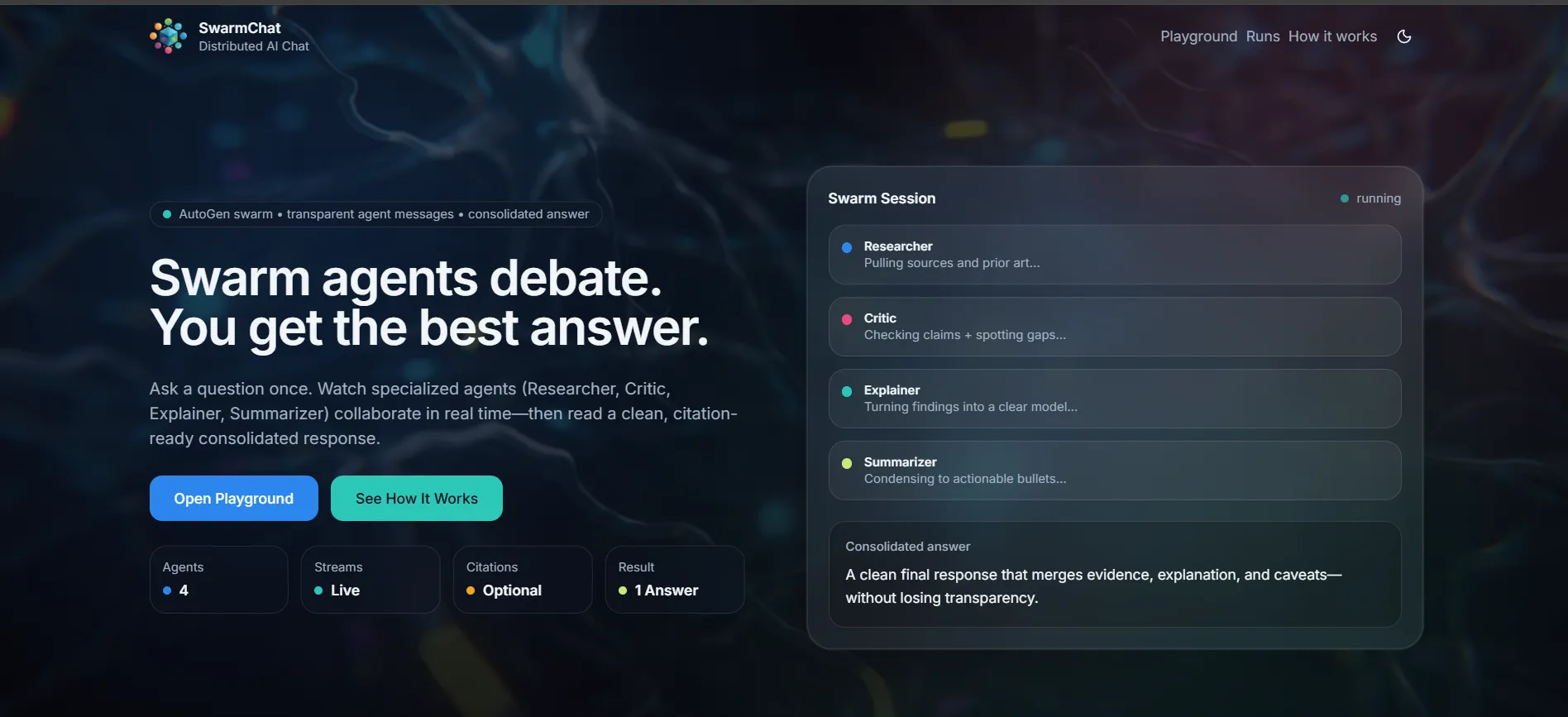
Ask a question once. Watch four specialized AI agents (Researcher, Critic, Explainer, Summarizer) collaborate in real time—then receive a polished, consolidated answer that synthesizes their collective intelligence using multi-agent orchestration with round-based collaboration, real-time transparency with live streaming via Server-Sent Events SSE, advanced conversation UX, complete feature set, and event-driven architecture
Best for
Users who need comprehensive answers to complex questions by analyzing questions comprehensively to identify key facts and research avenues, reviewing findings to identify gaps and potential risks, synthesizing information into clear, structured explanations, consolidating all perspectives into polished final answers, coordinating multiple research sources, and managing complex information synthesis workflows
Output
Full-stack distributed AI chat platform with Next.js 16.0.10 (React 19.2, TypeScript, Tailwind CSS, shadcn/ui, Server-Sent Events SSE) frontend, FastAPI backend (Python 3.11+, OpenAI GPT-4o-mini), Supabase PostgreSQL (schema: swarm), Upstash Redis (prefix: swarm), and deployment on Vercel (frontend) and Railway (backend)
Problem
Single-agent LLM systems suffer from structural limitations:
- •
One perspective dominates the response
- •
Errors or blind spots go unchecked
- •
Reasoning steps are opaque to the user
- •
Trust is hard to establish without transparency
Research and complex problem-solving benefit from multiple viewpoints, critique, and refinement — but most AI tools hide this process.
The challenge was to design a system that:
- •
Enables collaborative AI reasoning
- •
Makes agent interactions fully transparent
- •
Streams intermediate reasoning without overwhelming the user
- •
Remains fast, usable, and production-ready
Solution
I designed a swarm-based, multi-agent architecture where four specialized agents collaborate across structured rounds:
- •
Researcher — Analyzes the question and identifies key facts and constraints
- •
Critic — Reviews findings, challenges assumptions, and identifies gaps
- •
Explainer — Structures and clarifies the information into a coherent explanation
- •
Summarizer — Synthesizes all perspectives into a polished final response
Each agent:
- •
Has a dedicated prompt and responsibility
- •
Receives context from previous agents
- •
Streams output in real time to the UI
The result is a system that produces higher-quality answers while exposing how those answers were formed.
My Role
End-to-end AI Engineer (system design, AI orchestration, backend, frontend, infra)
Technical Architecture
AI & Agent Orchestration
- •
AutoGen-inspired swarm architecture with explicit agent roles
- •
OpenAI GPT-4o-mini for cost-efficient, high-quality agent responses
- •
Round-based execution with configurable number of refinement cycles
- •
Context sharing via transcript and partial-output propagation
- •
Carefully designed prompts to avoid role overlap and hallucination
Backend
- •
FastAPI (async Python) for orchestration and agent execution
- •
Server-Sent Events (SSE) for real-time streaming of agent outputs
- •
Redis (Upstash) for:
- •
Job queuing
- •
Ephemeral event buffering
- •
Supabase PostgreSQL for:
- •
Persistent threads
- •
Messages
- •
Analytics
- •
Schema-isolated multi-project storage
Frontend
- •
Next.js 16 + React 19
- •
Event-driven UI powered by SSE
- •
Per-agent panels showing live responses
- •
Thread dashboard with search, pagination, and deletion
- •
Analytics views for agent performance
- •
Markdown rendering with citation extraction
- •
Mobile-first, accessible design with dark/light mode
Deployment
- •
Vercel for frontend hosting (Edge-ready)
- •
Railway for backend API
- •
Cloud-native, production-grade infrastructure
Impact
This project demonstrates the practical benefits of agentic collaboration:
- •
Produces more robust and nuanced answers than single-agent systems
- •
Exposes reasoning steps, improving trust and interpretability
- •
Enables experimentation with agent roles, prompts, and collaboration strategies
- •
Serves as a foundation for research assistants, decision-support systems, and AI copilots
This project includes production-level features:
- •
Persistence
- •
Analytics
- •
Rate limiting
- •
Error handling
- •
Export and comparison tools
Challenges & Key Decisions
- •
Agent role design: Preventing overlap and prompt conflict
- •
Streaming complexity: Coordinating multi-agent SSE streams reliably
- •
UX transparency: Showing reasoning without overwhelming users
- •
Scalability: Designing for concurrent runs and multiple rounds
- •
Consistency: Synthesizing diverse agent outputs into a coherent final answer
These challenges closely mirror real-world distributed AI system design problems.
What This Project Demonstrates
- •
Multi-agent AI system design
- •
Agent specialization and prompt engineering
- •
Real-time streaming architectures (SSE)
- •
Event-driven full-stack systems
- •
AI transparency and interpretability
- •
Production-ready AI UX and infrastructure