AI-Powered Full-Stack SaaS Builder (Multi-Agent System)
FeaturedTransform a high-level SaaS idea into a production-ready full-stack starter in minutes. AI agents design your database, plan your API, craft your UI, and generate complete Next.js applications—all orchestrated seamlessly
This project is an AI-powered Full-Stack SaaS Builder that uses a multi-agent CrewAI workflow to generate complete, production-ready SaaS starters from a simple idea. From a single prompt, the system designs:
- •Database schemas and migrations
- •REST APIs and backend logic
- •Modern Next.js UI and components
- •Authentication and billing integration
Domain
- •AI Product Engineering
- •Developer Tools
Primary Users
- •Founders
- •Developers
- •Startups
Core AI Capabilities
- •Multi-agent orchestration
- •Planning
- •Code generation
What it does
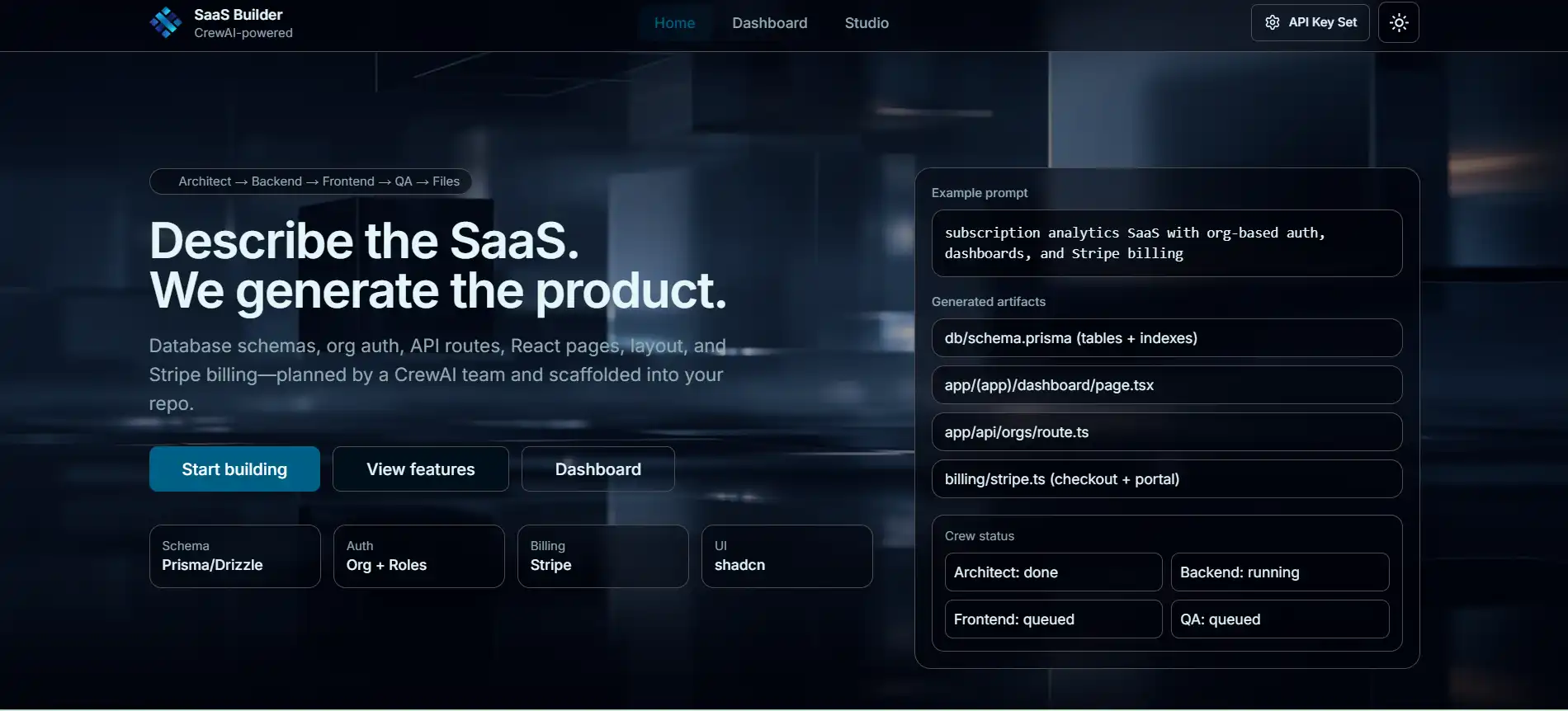
Transform SaaS ideas into complete applications using 4 specialized CrewAI agents (Architect, Backend Dev, Frontend Dev, QA) that generate database schemas, API routes, UI pages, React components, authentication, billing integration, and complete file structure with 120+ files, all with file tree explorer, diff viewer, ZIP downloads, run comparison, and billing and subscriptions
Best for
Developers and entrepreneurs who need to transform SaaS ideas into complete applications by designing database schemas, planning RESTful API routes, creating Next.js pages and React components, implementing authentication, integrating billing, ensuring production readiness, and coordinating application development workflows
Output
Full-stack SaaS builder platform with Next.js 16 (React 19.2, TypeScript, Tailwind CSS, shadcn/ui, next-themes) frontend, FastAPI backend (Python 3.11+, CrewAI multi-agent AI orchestration), OpenAI GPT-4o-mini, Supabase PostgreSQL , Upstash Redis , Stripe, and deployment on Vercel (frontend) and Railway (backend)
Problem
- •Building a SaaS product from scratch is slow and fragmented:
- •Founders struggle to translate ideas into technical architecture
- •Developers repeatedly rebuild the same foundations (auth, billing, CRUD)
- •AI code generators often produce disconnected or low-quality output
- •Most tools lack a holistic, system-level understanding of SaaS products
- •The challenge was to design a system that could:
- •Understand a high-level product idea
- •Break it down into coherent architecture
- •Generate integrated, production-ready code
- •Validate quality before delivery
Solution
I designed a multi-agent AI system where each agent has a clear, specialized responsibility, coordinated through CrewAI:
- Architect Agent designs the system architecture, database schema, and API surface
- Backend Agent refines APIs, normalizes schemas, and applies backend best practices
- Frontend Agent generates modern Next.js pages, components, and UX patterns
- QA Agent validates correctness, security, and production readiness
The result is a complete SaaS starter — not just code fragments — delivered in minutes.
My Role
End-to-end AI Engineer (system design, AI orchestration, backend, frontend, infra)
Technical Architecture
AI & Agent Orchestration
- •CrewAI coordinates a sequential, context-aware multi-agent workflow
OpenAI GPT-4o-mini used for:
- •Architectural planning
- •Code generation
- •QA validation
- •Context passing ensures each agent builds on prior outputs
- •Optimized prompts balance speed, cost, and quality
Backend
- •FastAPI (Python, async) for orchestration and API generation
- •Pydantic v2 for strict validation and schema safety
- •Redis (Upstash) for job queues, progress tracking, and rate limiting
Supabase PostgreSQL with:
- •RPC functions
- •Secure schema isolation
- •Migrations for generated databases
- •Stripe integration for subscription and billing scaffolding
Frontend
- •Next.js 16 + React 19
- •App Router with Server Components
- •Fully responsive, mobile-first UI
- •File tree explorer with syntax highlighting
- •Diff viewer and TODO detection
- •One-click ZIP downloads of generated SaaS starters
Deployment
- •Vercel for frontend hosting
- •Railway for backend API
- •Environment-based configuration and CI-ready setup
Impact
This system demonstrates how AI agents can compress weeks of early SaaS development into minutes:
- •Generates complete, integrated applications, not templates
- •Reduces cognitive load for founders and developers
- •Produces consistent architecture across database, API, and UI
- •Encourages best practices by default (auth, billing, validation)
This project is built to real-world developer-tool standards:
- •Multi-tenancy
- •Secure data access
- •Rate limiting
- •Error handling
- •Artifact lifecycle management
Challenges & Key Decisions
- •Agent boundaries: Defining responsibilities to avoid overlap or contradictions
- •Quality control: Ensuring generated code is coherent across layers
- •Speed vs depth: Optimizing generation to ~3–4 minutes without sacrificing structure
- •Context management: Passing enough information between agents without prompt bloat
- •Developer UX: Making generated output explorable, editable, and usable immediately
These challenges mirror real problems in agentic AI system design, not demo-level concerns.
What This Project Demonstrates
- •Multi-agent AI orchestration with CrewAI
- •End-to-end SaaS system design
- •Full-stack code generation (DB → API → UI)
- •AI-assisted developer tooling
- •Production-grade backend and frontend architecture
- •Practical application of LLMs beyond chat interfaces