Autonomous Data Labeling Platform (Human-in-the-Loop ML)
FeaturedProduction-grade, AI-powered human-in-the-loop data labeling system with active learning and quality assurance
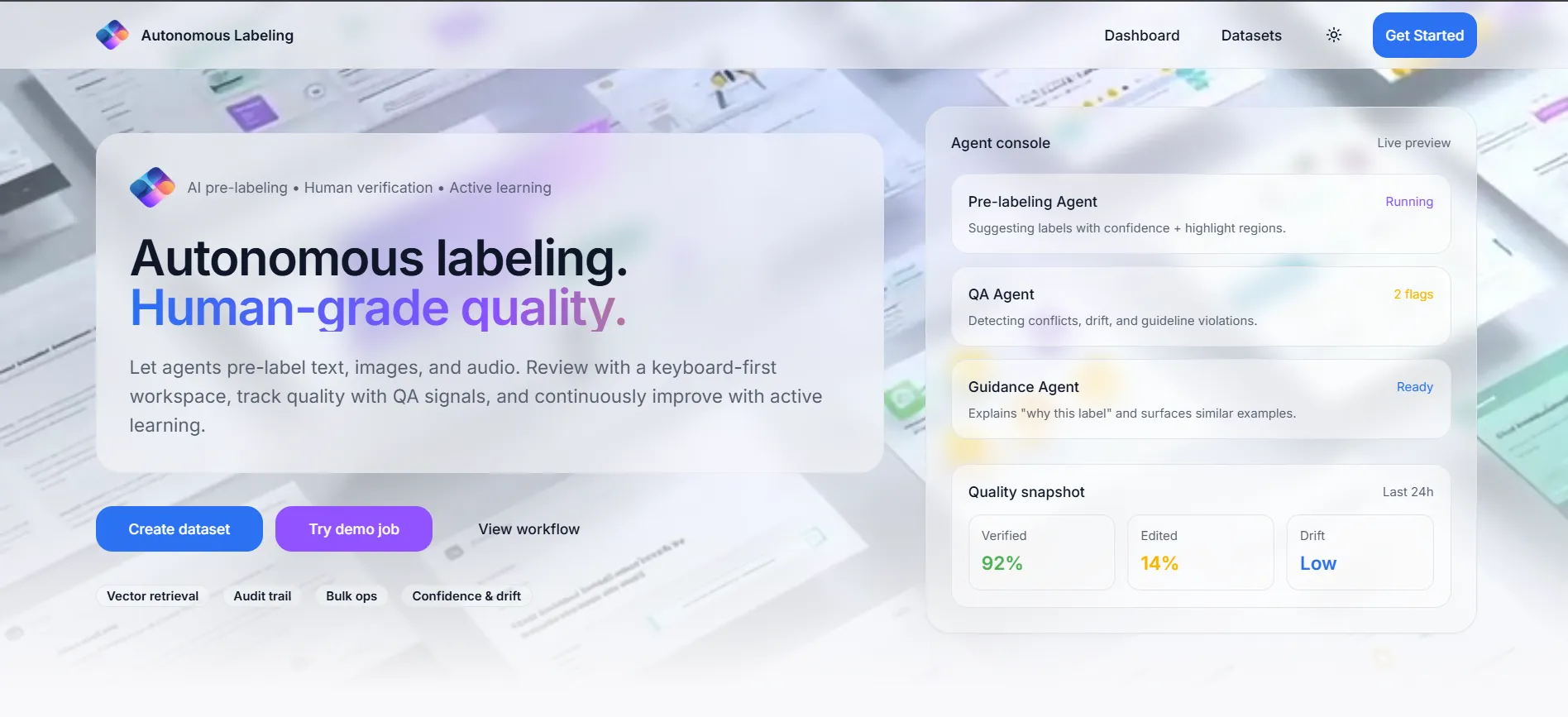
This project is a full-stack Autonomous Data Labeling Platform designed to accelerate machine learning pipelines by combining AI pre-labeling, human verification, and active learning in a single, production-ready system.
The platform addresses one of the biggest bottlenecks in applied AI: high-quality labeled data at scale.
Domain
- •ML Operations
- •Data Engineering
- •AI Infrastructure
Primary Users
- •ML Engineers
- •Data Scientists
- •AI Teams
Core AI Capabilities
- •Pre-labeling
- •Confidence Scoring
- •Active Learning
- •Human-in-the-loop Workflows
What it does
Orchestrate the complete data labeling workflow from raw data to production-ready labeled datasets using AI pre-labeling (GPT-4.1-mini generates draft annotations with confidence scores), smart verification (keyboard-first workspace optimized for rapid human review), active learning (intelligent queue prioritization surfaces items needing attention), quality assurance (automated conflict detection, drift monitoring, and quality metrics), and continuous improvement (active learning loop refines model suggestions based on human feedback), all powered by CrewAI orchestration
Best for
ML teams who need to create production-ready labeled datasets by AI pre-labeling with structured outputs comprehensively, generating draft annotations with confidence scores, providing keyboard-first workspace for rapid human review, implementing active learning for intelligent queue prioritization, coordinating quality assurance with conflict detection and drift monitoring, and managing data labeling workflows
Output
Full-stack data labeling platform with Next.js 16.0.10 (React 19.2, TypeScript, Tailwind CSS, shadcn/ui, Recharts, Lucide Icons) frontend, FastAPI backend (Python 3.11+, OpenAI SDK with GPT-4.1-mini, CrewAI, Pydantic v2), Supabase PostgreSQL with pgvector extension (schema: labeling-platform), Upstash Redis (prefix: labeling-platform:), Supabase Storage, and deployment on Vercel (frontend) and Railway (backend)
Problem
- •Training reliable ML and AI systems requires large volumes of accurately labeled data, but traditional labeling workflows are manual and slow, expensive to scale, error-prone without strong QA, and poorly integrated with ML feedback loops.
- •Existing tools often focus on either automation or human labeling, but not both, and rarely with production-grade UX, analytics, and data quality guarantees.
- •The challenge was to design a system that uses AI to accelerate labeling, not replace humans, surfaces high-value items for review, ensures data quality, traceability, and trust, and feels fast enough for real, daily use.
Solution
I designed and built an AI-powered human-in-the-loop labeling platform that orchestrates the full lifecycle from raw data to production-ready datasets:
- •1. AI pre-labels items with confidence scores using structured outputs
- •2. Humans verify and correct labels in a keyboard-first workspace
- •3. An active learning loop prioritizes uncertain or conflicting items
- •4. Quality metrics, analytics, and audit trails ensure trust and consistency
- •5. Verified datasets are exported in formats ready for training
- •The system supports text, image, and audio workflows and is built to production standards from day one.
My Role
End-to-end AI Engineer (architecture, backend, frontend, ML ops, deployment)
Technical Architecture
AI and ML Operations: OpenAI GPT-4o-mini for fast, structured pre-labeling, GPT-4.1-mini for contextual chat assistance, Whisper API for audio transcription, confidence scoring (0.0 to 1.0) with calibrated thresholds, CrewAI adapter available for multi-agent workflows (direct OpenAI calls used in production), active learning heuristics to prioritize low-confidence or conflicting items
Backend: FastAPI (async Python) for high-throughput labeling operations, Pydantic v2 for strict schema and payload validation, RPC-based database access with schema isolation, Redis (Upstash) for job queues, caching, and rate limiting, Supabase PostgreSQL plus pgvector for data storage and similarity search
Frontend: Next.js 16 plus React 19, Server Components, Suspense, optimistic updates, keyboard-first labeling UX (J/K/A/S shortcuts), real-time updates for jobs, analytics, and annotations, fully responsive, mobile-optimized interface
Deployment: Vercel for frontend hosting, Railway for backend API, cloud-native, production-ready infrastructure
Impact
- •This platform demonstrates how AI can dramatically reduce labeling effort while improving data quality: AI pre-labeling reduces manual effort per item, active learning focuses human attention where it matters most, structured outputs and validation reduce downstream training errors, real-time analytics provide visibility into data quality and drift
- •This project is built to enterprise ML-ops standards: Audit trails, schema validation, rate limiting, quality metrics, secure data access
Challenges & Key Decisions
- •Confidence calibration - designing scores that meaningfully reflect uncertainty
- •Human-AI balance - avoiding blind trust in AI suggestions
- •UX speed - achieving less than 100ms navigation for labeling workflows
- •Data quality - preventing silent label drift and conflicts
- •Scalability - supporting large datasets with async pipelines and caching
These challenges mirror real-world ML infrastructure problems, not demo-level concerns.
What This Project Demonstrates
- •ML operations & data engineering
- •Human-in-the-loop AI system design
- •Active learning and uncertainty handling
- •Full-stack AI product delivery
- •Production-grade UX for power users
- •Scalable backend and cloud deployment