AI-Driven Knowledge Graph Builder (LangGraph + Neo4j)
FeaturedTransform unstructured text and web content into interactive knowledge graphs. Extract entities, discover relationships, and explore connections through sophisticated graph visualization—all powered by advanced AI.
Overview
This project is an AI-driven knowledge extraction and graph construction platform that converts unstructured content into structured, explorable knowledge graphs.
Using a LangGraph-orchestrated, multi-agent pipeline, the system ingests text or URLs, extracts entities and relationships with AI, stores them in a graph database, and provides rich visual and query interfaces for exploration.
Domain: Knowledge Engineering / Graph AI / AI Infrastructure
Primary Users: Researchers, analysts, developers, knowledge workers
Core AI Capabilities: Entity extraction, relationship modeling, graph querying
This project demonstrates how LLMs can be used to build structured knowledge systems, not just generate text.
What it does
Intelligent knowledge graph platform that transforms unstructured text and web content into explorable graph structures using advanced AI extraction, sophisticated graph modeling, and interactive D3.js visualization
Best for
Researchers, analysts, and organizations who need to extract meaningful insights, relationships, and patterns from large volumes of unstructured text and web content
Output
Full-stack knowledge graph platform with Next.js 16 frontend, FastAPI backend, LangGraph workflow orchestration, Neo4j graph database, Supabase PostgreSQL, and Upstash Redis
Problem
Most AI systems operate on unstructured text, which limits:
- •
Long-term memory and reasoning
- •
Relationship discovery across documents
- •
Traceability and explainability
- •
Advanced querying beyond keyword search
Traditional knowledge graph tools are powerful but:
- •
Difficult to set up
- •
Require manual schema design
- •
Don't integrate well with modern AI workflows
The challenge was to build a system that:
- •
Automatically extracts entities and relationships
- •
Preserves provenance and confidence
- •
Supports interactive exploration
- •
Bridges LLMs with graph-native storage
- •
Remains production-ready and scalable
Solution
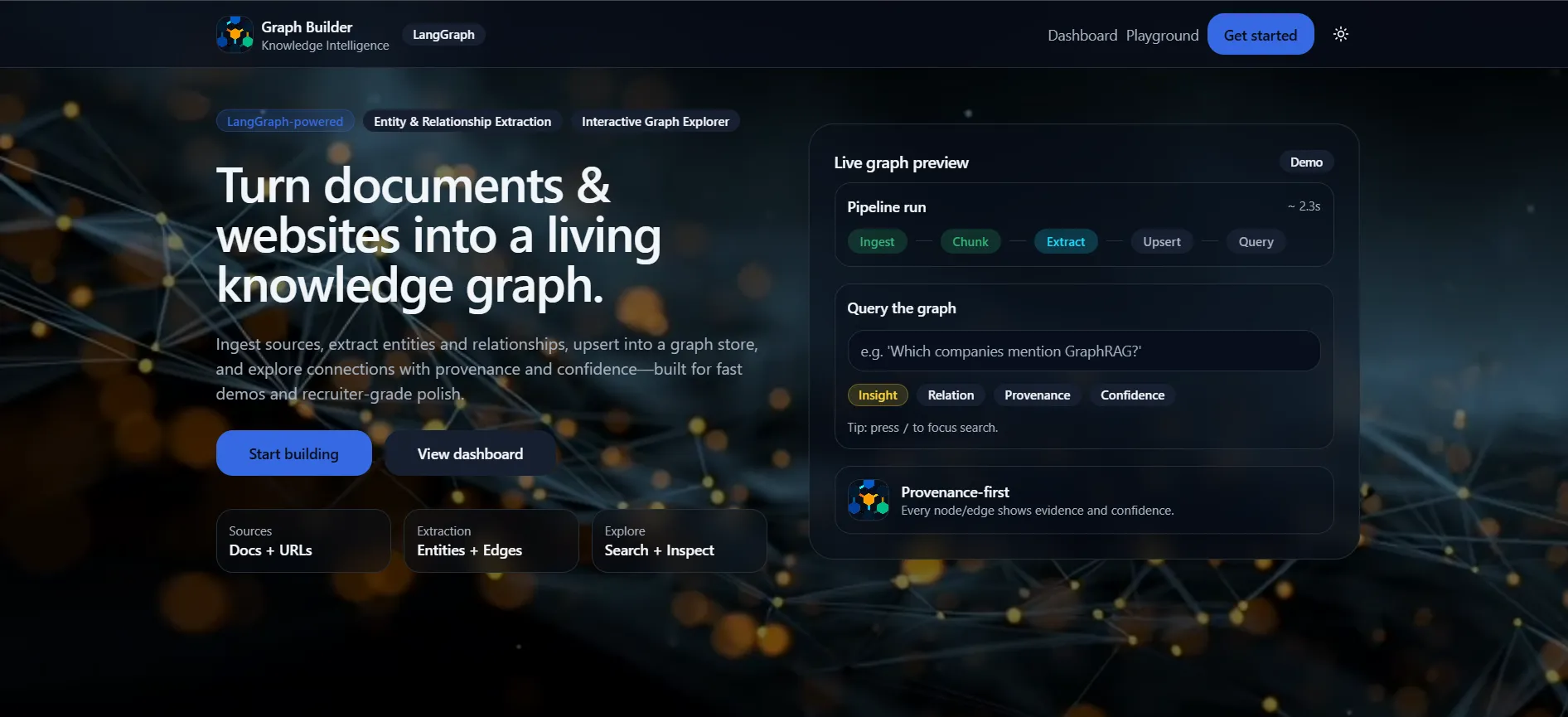
I designed a multi-stage, AI-driven knowledge graph pipeline orchestrated with LangGraph:
- •
Content Ingestion — Accepts raw text or fetches content from URLs
- •
Chunking & Preprocessing — Splits content for reliable extraction
- •
AI Extraction — Uses structured LLM outputs to identify entities and relationships
- •
Graph Construction — Normalizes, deduplicates, and upserts nodes and edges into Neo4j
- •
Visualization & Querying — Enables interactive graph exploration and natural language queries
The result is a system that turns raw information into structured, navigable knowledge.
My Role
End-to-end AI Engineer (architecture, AI orchestration, backend, frontend, deployment)
Technical Architecture
AI & Orchestration
- •
LangGraph for orchestrating ingestion, extraction, and graph construction
- •
OpenAI GPT-4o-mini with structured outputs for:
- •
Entity extraction
- •
Relationship discovery
- •
Confidence scoring and provenance tracking per extraction
- •
Deterministic, extensible pipeline design
Backend
- •
FastAPI (async Python) for orchestration and APIs
- •
Pydantic v2 for schema validation
- •
Supabase PostgreSQL for:
- •
Run metadata
- •
Documents and chunks
- •
Extraction results
- •
Neo4j as the graph database for:
- •
Entity nodes
- •
Relationship edges
- •
Redis (Upstash) for job tracking, caching, and rate limiting
Frontend
- •
Next.js 16 + React 19
- •
D3.js force-directed graph visualizations
- •
Interactive graph exploration (pan, zoom, filter, highlight)
- •
Natural language query interface
- •
Dark/light mode and responsive design
Deployment
- •
Vercel for frontend hosting
- •
Railway for backend API
- •
Neo4j Aura and Supabase Cloud for managed databases
Impact
This project demonstrates how AI + graph databases can unlock new capabilities:
- •
Converts unstructured content into structured knowledge
- •
Enables discovery of hidden relationships
- •
Supports natural language graph queries
- •
Improves explainability through explicit entities and links
- •
Scales beyond embedding-only approaches
This project reflects enterprise-grade knowledge engineering patterns.
Challenges & Key Decisions
- •
Schema design: Balancing flexible extraction with normalized graph models
- •
Deduplication: Preventing entity explosion across runs
- •
Visualization performance: Rendering large graphs smoothly in the browser
- •
Extraction quality: Ensuring structured outputs remain reliable
- •
Pipeline robustness: Handling partial failures gracefully
These challenges mirror real-world knowledge graph and AI infrastructure problems.
What This Project Demonstrates
- •
Knowledge graph engineering with Neo4j
- •
AI-driven entity and relationship extraction
- •
LangGraph-based multi-stage orchestration
- •
Advanced data visualization (D3.js)
- •
Full-stack AI system design
- •
Production-ready AI infrastructure